“Engineering needs people who care about the world and want to make a difference. Technical skills can be taught much more easily than empathy or teamwork.”
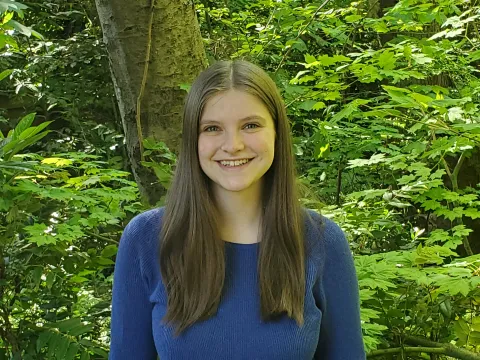
Shaylin Cattell
- Degree:
- Bachelor of Applied Science
- Grad year: 2021
- Program:
- Campus: Vancouver
My name is Shaylin, and I’ve lived in Vancouver for seventeen years. I grew up loving math, logic puzzles, and mystery novels — anything that challenged my problem-solving skills!
During my degree I had three co-op jobs. Through an NSERC USRA, I was an undergraduate research assistant in the UBC Department of Electrical and Computer Engineering. I also worked at Intel as an embedded systems engineer and at Microsoft as a firmware engineer. During my work terms, I co-authored two publications, one in ISPASS 2019 and one in MICRO-53, as well as contributed to a presentation at the Linux Plumbers Conference Android micro-conference. I also worked as a teaching assistant for CPEN 221: Principles of Software Construction. I will be returning to Microsoft as a full-time firmware engineer later this year.
Why did you choose to go into your field of study at UBC?
I attended a couple of the UBC Engineering open houses when I was in high school, and I really loved the sense of community that engineering seemed to have. I was looking for a degree that could challenge me, but would also be practical. The co-op program at UBC seemed like an excellent opportunity to explore career options and discover what I might want to do after graduation.

What has made your time at UBC memorable?
Doing co-op was the most memorable experience for me. I had the opportunity to work in very different jobs — as a research assistant, at a hardware company, and at a software company — which gave me the chance to explore different fields I might be interested in and led to a full-time position after graduation.
I also loved being a teaching assistant for CPEN 221. I ran labs and office hours, which gave me the opportunity to connect with younger students in my program in a meaningful way. I tried to be the type of TA I would have loved to have: someone who tells you that it’s okay to feel like an imposter and to not know everything.

How are you applying the skills you learned through your studies at UBC?
In each of my co-op jobs, I was very grateful for what I had learned at UBC, whether it was a programming language, a design technique, or general problem-solving and critical-thinking skills. Applying theories I’d learned to real-life problems was satisfying, and it made me eager to learn more when I returned to campus after each job.
How do you feel your degree has benefitted you compared to a different field of study?
Engineering has given me an appreciation for solving problems in both creative and logical ways.
Through computer engineering, I’ve been able to explore computer systems from the lowest hardware level to high-level software design. It’s given me the ability to look at a system or problem as a whole, and then break it down into smaller parts so that each individual problem can be solved. Engineering promotes a more holistic approach than other programs I’ve seen. It’s not just about the individual technical problem in front of you. The context of the problem, the ethical or environmental implications, and the need it’s fulfilling are all pieces that matter too.

What are your future plans to make a difference in our world?
While at Microsoft, I’m planning to join groups supporting diversity and sustainability in STEM. I would like to mentor women who are interested in engineering throughout my career. Also, I will continue to volunteer in other important areas, including food stability and environmentalism.


