“A graduate engineering degree opens doors to amazing opportunities, but requires hard work, dedication and most importantly, the willingness to learn and fail. Come in with an open mind, leave with a wealth of knowledge and mark your contribution...”
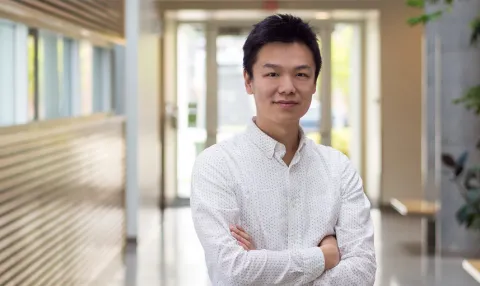
Kevin Chen
- Degree:
- Master of Engineering Leadership
- Grad year: 2018
- Program:
- Campus: Vancouver
I have an insatiable curiosity for knowledge and the innate need to understand the world. Throughout my career in science and engineering, I have always been fascinated with solving complex problems and understanding the implications of technological innovation. After three years of working in civil engineering, I wanted to learn more about the future of infrastructure and enrolled in the Master of Engineering Leadership in Urban Systems. During this one-year program, my team and I have taken on a variety of challenging projects such as “Planning Sapperton District Energy Site’s Strategy for City of New Westminster,” “Developing an Asset Management Plan for City of Vancouver’s Pavement Infrastructure” and “Conceptualizing Sustainable and Livable Brownfield Redevelopment in Blatchford Edmonton.” To understand the impact of data on sustainability, I collaborated with a classmate on a research project using UBC Campus Wi-Fi data to assess building occupancy. In addition to my classes, I represented Applied Science graduate students on the President’s Committee to select the next dean of Applied Science.
Why did you choose engineering?
I have always been fascinated with transportation and cities. Playing with train sets and Lego filled my childhood and shaped my learning experience. As I grew older, I realized that everything fundamental to modern society is based on infrastructure, which is designed by engineers who put a lot of thought and rigor into their craft. With an eagerness to learn about design and the desire for impact-driven work, I became enamoured with engineering as a career path.
What has made your time at UBC the most memorable?
Through my lens, I see UBC as an inviting and collaborative learning space that not only focuses on academic excellence, but also explores and challenges the way we think, which is something that is rarely found in our working lives. With this perspective in the back of my mind, I took the opportunity to led the UBC team in the national CanInfra challenge competition. Our multidisciplinary team, made up of students with backgrounds in civil engineering, project management, technology, politics and finance, competed in Toronto for the final competition. For me, this was the most memorable experience at UBC because it truly lived up to the “living lab” and “innovative” focus that makes UBC one of the best schools to study engineering.
What have you learned in engineering that is most valuable?
My first engineering experience was quantifying municipal assets as a summer intern. This was a great introduction to asset management, but I wanted the excitement of working at the “front lines.” For this reason, my next role was field engineering for large-scale oil and gas, land development and hydro projects. It is during this time that I was exposed to the complexity behind infrastructure management and I was fascinated by it. During my master’s program, I was selected as a Greenest City Scholar and supported the City of Vancouver to “green” their engineering operations. Through my three years of work experience, I have led an interesting and diverse journey.
I believe all the key elements to a successful engineering career can be summed up by the attitude we have towards our work. Through trials and tribulations, I have learnt that having the right attitude is the biggest contributor to success and happiness with this career.
How are you applying the skills you learned through your studies at UBC?
The technical and business skills I learnt from my time at UBC are quite useful for my career endeavors. But what really propelled me forward is the ability to understand impacts of next generation technology on infrastructure, a topic that was central to my studies.
What has been your most memorable/valuable non-academic experience studying engineering at UBC?
For me, the most memorable experience was the gala dinner for our program. By the end of the year, everyone had become good friends and this gala was the “high-water mark” of our cohort. During this year, I have met so many amazing people and it’s nice to think that in the fabric of time, all our lives were woven in and this experience will influence our success in the years to come.
How do you feel a graduate degree in engineering has benefitted you compared to a different field of study?
Engineering teaches us to think in a structured analytical way and a graduate degree helps us gain mastery over a specific topic. For me, these attributes formed the foundations to all pillars of my other skillsets, which opened the doors to great opportunities.
What advice would you give a student considering a graduate degree in engineering?
A graduate engineering degree opens doors to amazing opportunities, but requires hard work, dedication and most importantly, the willingness to learn and fail. Come in with an open mind, leave with a wealth of knowledge and mark your contribution with your work.
Where do you find your inspiration?
I would look back in time to our history and look forward to our future. In the past, scientists and engineers changed the world with their novel solutions. In the future, innovation such as Internet of Things, Blockchain and quantum computing will unlock remarkable opportunities. By exploring our past and future, I feel empowered to transform our world and this generates the impetus to motivate myself.
What are your plans for the future?
In the future, I want to contribute towards sustainability and livability in the urban landscape, through improved project management, infrastructure delivery, strategy and digital transformation.
How will you go on to make a difference in our world?
There are so many ways I can make a difference in our world and right now I want to focus on infrastructure: my goal is to build infrastructure that is thoughtful — so that we can accommodate everyone’s needs — and innovative — so that we can bridge the gap to a better tomorrow.
