“This degree has been a transformative experience in how it’s changed my approach to solving problems and being rigorous and methodical. One of the biggest skills has been developing an eye for the ‘big picture.'”
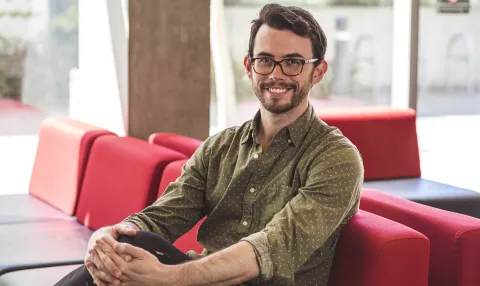
Andrew Cote
- Degree:
- Bachelor of Applied Science
- Grad year: 2019
- Program:
- Campus: Vancouver
I grew up in Vancouver and as a kid, had a love for all things Lego. So naturally, I studied sociology and planned to become a lawyer. After realizing that law wasn’t right for me, I worked in marketing and sales in the property development industry while planning my next move. Somehow along the way, I gained a weird obsession with physics, and soon realized that it was time to make a big career change if I wanted it to be more than a hobby.
I chose UBC Engineering Physics because it would give me the theoretical foundation to work in physics research with the engineering skills to design and build my own tools and experiments.
Throughout my degree I’ve been fortunate to work in applied physics research at TRIUMF, General Fusion, Quantum Matter Institute at UBC and most recently, Stanford Linear Accelerator in California. The combination of experimental physics and engineering design has proved to be a very rewarding and challenging field to work in, and I’m looking forward to a career developing new technologies using the skillset I gained at UBC.
What has made your time at UBC the most memorable?
I’d like to say the late nights and endless assignments stand out, but truthfully they all blur together in hindsight. One surprise looking back was that my intention at UBC was to pick up a technical skill set so I could ‘do physics,’ and along the way I ended up something equally valuable — a tight-knit community of fellow engineering physics students that are ambitious, passionate and immensely talented. I’ve been very fortunate to learn a lot from them and push myself harder and hold a higher standard of work just to keep up. It’s been a pleasure being a part of, and giving back, as much as I can to this community, and I’ve learned that cultivating a supportive, ambitious and driven community of co-workers makes ‘work’ the kind of activity that can be enjoyable and satisfying… in moderation.

How do you feel a degree in engineering has benefitted you compared to a different field of study?
I came to engineering with a degree in sociology, but I didn’t think of myself as a sociologist. However, now I do think of myself as an engineer. This degree has been a transformative experience in how it’s changed my approach to solving problems and being rigorous and methodical.
One of the biggest skills has been developing an eye for the ‘big picture’ — what is this project for, who does it help and why should we care? — and using that to generate design requirements and inform technical decision-making.
As engineers I think we need to be aware of the social impact of our design decisions have and empathize with who will use and be affected by the things we develop. Otherwise you’re just building Death Stars — cool science, but mighty un-neighborly.


Where do you find your inspiration?
I’ve been fortunate to sample from a few different areas of engineering research and development in a few different roles — from condensed matter physics, to wireless communications — as everything from a mechanical engineer, to data scientist, to whatever goes between. I’ve discovered my biggest inspiration is in working on giant physics experiments like the ones I saw at General Fusion, TRIUMF and Stanford Linear Accelerator. It’s electrifying; there’s something about standing next to a 100 kilo-volt amplifier that makes your hair stand on end. You realize that these are the cathedrals of the modern era, projects that take national budgets and hundreds of specialized and skilled artisans to make work. The reward is a peek at the mind of God (whoever she is). These projects spawn whole new fields and technologies that enable the next revolution to take place, from quantum computers to medical imaging; these experiments are foundational to levelling up as a species.
How will you go on to make a difference in our world?
One thing I’ve learned while at UBC is that being a part of a healthy and thriving community provides a tremendous sense of purpose and meaning. There are few experiences better than being part of a group of ambitious, motivated and optimistic people dedicated to applying themselves and having fun while doing it. You start asking yourself, not only “who could I become?”, but “who do I need to be?” and “what is the high-value thing I can do that no one else can?”.
If you can see the world being a better place because of a course of action you can take, whether it be developing a new technology, starting a company or simply phoning a friend to see how they’re doing, then I think you have a responsibility to do just that.
That’s the only way things get better with time.