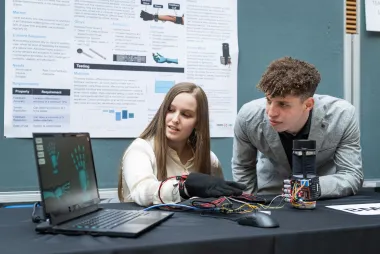
"If you’re considering engineering and want to challenge yourself, go for it. Don’t be intimidated. Engineering is a powerful degree that opens up so many options, from working in industry or research to medicine, law and many other fields."

Emily Boyle
- Degree:
- Bachelor of Applied Science
- Program:
- Campus: Vancouver
Why did you want to study biomedical engineering?
Both of my parents are engineers – my dad is a computer engineer and my mom is a mechanical engineer – so I always knew what engineering was about and considered it as an option. In high school, I loved problem solving, especially in my math and physics classes.
I’m ultimately interested in pursuing medicine. Engineering isn’t always the easiest path to med school, but UBC’s biomedical engineering program builds medical school perquisites into the degree. I applied to the PBME (Pre-Biomedical Engineering) stream and was accepted for first year.
PBME was great. You take a lot of courses, but because you share a timetable with everyone else and it’s a small program, you quickly get to know your classmates and make friends.
PBME (Pre-Biomedical Engineering) stream

What are some of the highlights of your time at UBC?
The people at UBC are amazing. I think this is because of the type of students who are attracted to UBC – people who care about academics but are also interested in other things too.
When I talk with friends at other universities in Canada, I get the sense that it’s more competitive and that there is less balance.
In terms of courses, I loved a course on biomaterials and drug delivery. Going into it, I had no idea that this is something that I would like, but the professor was amazing and got me very interested in this field.

Another great course was on cellular bioengineering lab and design.
This one was interesting because you were responsible for designing and executing your own lab experiment. Our group tested the effects of timing of retinoic acid application on muscle cell growth. We wrote a proposal, came up with a list of materials and experimental procedure, and carried out the experiment.
I’ve enjoyed a course on biomechanics – I love physics so applying it to the human body was fun. Also, anatomy labs at the Life Sciences Centre, where instructors teach using cadavers, provide a unique hands-on learning experience in our anatomy and physiology course, allowing students to directly examine and handle anatomical specimens.
Has engineering changed the way you approach problems?
Definitely. When I was younger, if I was faced with a difficult problem, I might have assumed I wasn’t qualified enough or didn’t know enough to solve it.
Engineering teaches you that problems that seem overwhelming are actually solvable. You just need to break them down into multiple steps.
You are introduced to the design process right in first year, which provides a framework or structure to solve complex problems.

Do you feel that you have changed as a person since starting university?
Moving away from home and living on your own requires you to grow up quickly because you are entirely responsible for yourself. I have also gained a new perspective on myself.
Many people who come into engineering were at the top of their classes in high school. When you arrive on campus, you realize that everyone else was that person too. It forces you to rethink your identity and discover who you are beyond academics.
What advice would you give people considering engineering?
If you’re considering engineering and want to challenge yourself, go for it. Don’t be intimidated. Engineering is a powerful degree that opens up so many options, from working in industry or research to medicine, law and many other fields.
Also, I’d highly recommend UBC. The Engineering Undergraduate Society is super cool and has created a wonderful sense of community where everyone is genuinely excited about studying engineering.
Engineering Undergraduate Society