- Program:
- Campus: Vancouver
Dr. Cyrus Neary
“I am exploring how to develop and integrate methods in artificial intelligence—like language understanding and learning from data—into reliable engineering systems, with a focus on robotics and autonomy.”
Tell us about your academic journey.
One of the best decisions I made was to study Engineering Physics at UBC as an undergrad. Although the program was rigorous and busy, it immersed me in a fantastic group of students and amazing professors.
Initially, I planned to work in industry right away, but my co-op terms changed that.
My first co-op was with D-Wave Systems, a quantum computing company. I also worked on R&D teams for MDA Space, both here in BC and in Ontario. My mentors in those roles had all done graduate work, and I realized that to do the kind of research I was interested in, a PhD was essential.
All of that led me to the Oden Institute for Computational Engineering and Sciences at the University of Texas at Austin, where I began working on autonomous system design. I worked with Professor Ufuk Topcu as a member of the Center for Autonomy and was also a member of the Center for Scientific Machine Learning.
Can you describe the main themes of your research?
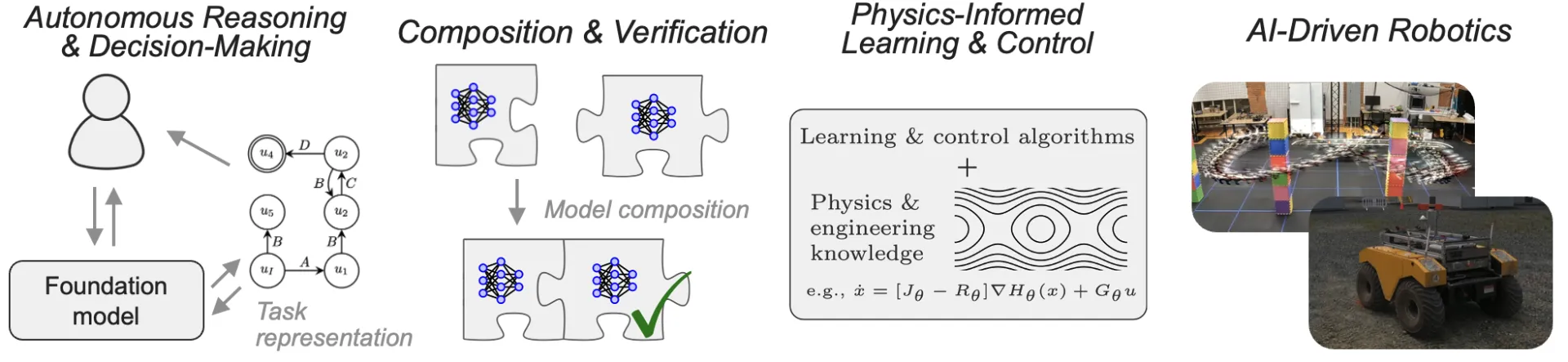
The big picture is that I am developing intelligent autonomous systems that are safe and ready to be deployed in a variety of settings. Potential applications include robots interacting naturally with people using language, and autonomous aerial or underwater vehicles. This capability could even extend to autonomous infrastructure-level decision-makers that improve the safety and reliability of the systems our society depends on.
There are a few major threads:
- Autonomous reasoning and decision making:
I am interested in how autonomous systems can reason about their missions and adapt to unexpected events without human intervention. For example, imagine a robot operating in the Canadian Arctic or helping with disaster response to something like a wildfire. How do we mathematically specify and verify the desired behaviours of this kind of system? How do we ensure they follow critical safety specifications?
- Compositionality and verification:
Complex systems are built from simpler parts. I’m researching how to design compositional AI systems—robots that learn simple skills (like “pick up” or “place”) and then create algorithms to stitch these tasks together, potentially even involving multiple cooperating robots. Compositional design also makes systems easier to analyze from an engineering perspective.
- Mixing physics-based modelling with deep learning:
Data-driven methods and deep learning are very powerful, but the problem is that there’s no guarantee that the models they generate will follow the laws of physics. I’m working on combining physics knowledge with learning-based methods, especially for control problems—like modelling how a drone flies or how power networks respond to renewable energy inputs.
- Bridging simulation and real-world deployment:
AI methods often rely on simulators due to data requirements, but there’s a gap between simulation and reality. I’m exploring algorithms to smooth this gap, so systems trained in simulation can adapt to real-world conditions, which may differ significantly.
What’s your view on AI integration with engineering?
I see AI as a tool or assistant that can speed up work and improve quality, even serving as an educational resource. But coming from an engineering philosophy that emphasizes safety and reliability, I’m hesitant to say AI can or should do everything for us. If we are integrating AI into our workflows and engineering systems, we need to adapt and develop new engineering methodologies.
Mechanical and civil engineering have established design principles, such as safety factors and redundancy, but comparable, widely accepted design principles don’t yet exist for AI-integrated systems. We haven’t had enough time to develop them or to learn from failures. One way or another, AI will be a big part of our future, and I hope we can figure out how to use these tools responsibly.
One of the most valuable parts of an engineering education is reflecting on the impact of the technologies we are building and ensuring we act responsibly in that light.
The iron ring is a great symbol of that mindset.
Any reflections on how engineers are building and shaping our future?
Engineers play a crucial role in building and shaping the future, alongside artists, policymakers and others. Many engineers keep society running by building critical infrastructure, while others develop future technologies that will shape society in the years to come. One of my favourite parts of being an engineer is working on projects that may seem abstract at first, but become tangible when you see them in action—like the first time I saw a robot move because of an algorithm I’d written. It all links back to those early experiences at Geering Up!