Karan Bakhshi, Martin Edwini-Bonsu, Kasish Mahajan, Ryan Parissay, Sarang Sai Narain and Devin Sutton
- Degree:
- Bachelor of Applied Science
- Program:
- Campus: Vancouver
Our project
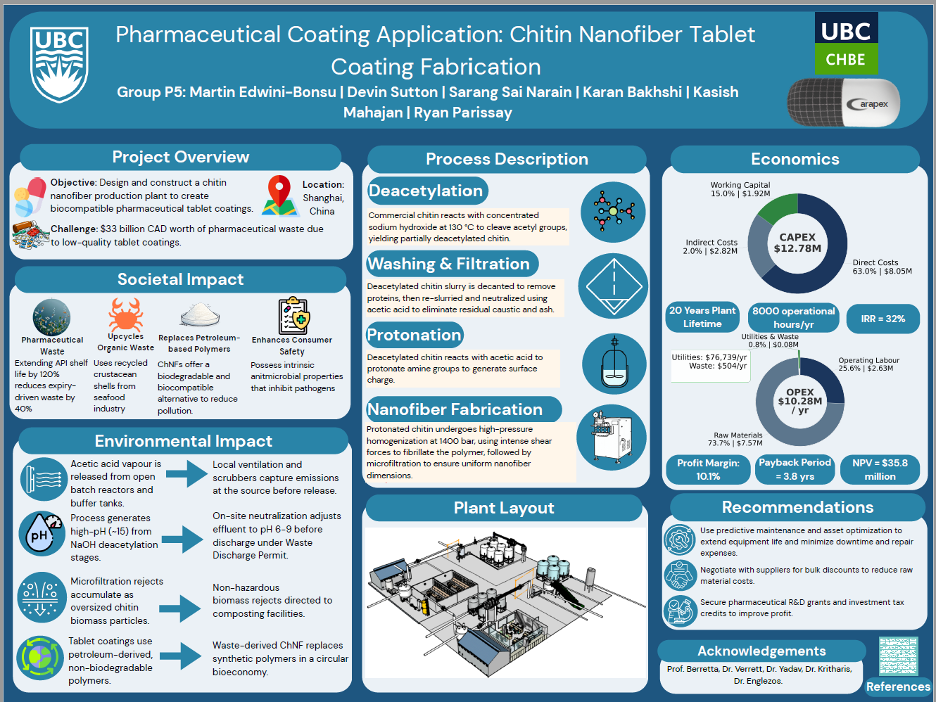
Pharmaceutical tablets are typically coated with petroleum‑derived polymers that break down under oxygen and moisture, accelerating drug degradation and leading to billions of dollars in preventable waste. We’ve developed a tablet coating made from chitin nanofibers, a sustainably sourced biopolymer made from crustacean shells. Chitin provides a significantly stronger barrier against oxygen and moisture than the current approach and can dramatically extend the shelf life of pharmaceutical tablets by up to 120%.
This solution would help reduce the estimated $33 billion in expiry-driven global pharmaceutical waste generated each year due to low-quality tablet coatings.
Our design solution
We source our chitin from crab shells through a four-step process: deacetylation to make the end product more resistant to water and oxygen, followed by washing and filtration, protonation of amine groups and finally nanofibre fabrication to ensure uniform dimensions.
Our proposed facility is capable of producing 6.86 billion tablets annually with anticipated gross annual revenues of just over $50 million.
We chose chitin because it is already being used in human food products and therefore does not require extensive regulatory testing to prove that it is safe for human consumption. Chitin has all the properties we need in a tablet coating, primarily its low oxygen and moisture permeability.
The design solution evolved over the course of the project. Chitin can be derived from crustacean shells as well as certain vegetables, and this decision influenced our production process, including where it makes the most economic sense to locate our production. We’re currently locating our facility in Shanghai, where we have access to locally sourced crab shells as one of our primary feedstocks and where the economics are feasible.
The technical challenges we faced
The primary challenge was finding reliable and accurate lab data and translating those results into a realistic, scalable industrial process. Another challenge was choosing our feedstock source and site location. While we initially considered using vegetable-based feedstock and siting our facility in Japan, more detailed technical and economic analyses revealed that this wasn’t feasible at scale.
What we’re most proud of
It’s been genuinely rewarding to work on a sustainability-focused innovation that replaces fossil-fuel-derived polymers like PVA with a biopolymer to solve a significant problem in the pharmaceutical industry. Similarly, it’s also been rewarding to integrate the knowledge we have built through our coursework and co-op work terms and apply it to a project that has tangible benefits.
Stepping back, it’s been interesting to see the sheer scope of this project. When you start out in engineering, you have a simplified understanding of design as a linear process. This project reinforced that industrial-scale design is far more complicated. It takes a long time and there are so many interconnected factors – technical, economic, environmental, operational – that all have to be considered together.