Closing the loop: Turning textile waste into feedstock

Textile Waste Project Team Picture

Diana Davis, Tanveer Dhaliwal, Dhruv Goel, Markus Kaiser, Michelle Peng and Ilenna Wen

Our project

Clothing waste contributes significantly to landfilling and incineration. The average US consumer throws away more than 80 pounds of clothing a year, and only 12% of textiles are currently being recycled. Blended fabrics – particularly polycotton blends – remain a major challenge as we don’t yet have an effective way to recycle them.

We partnered with Lululemon to create a process that contributes to the circular economy by converting the cotton in textile waste into glucose via acid hydrolysis. This process diverts 50,000 tonnes of polycotton textile waste from landfills each year while generating valuable byproducts, including glucose (which can be used as a feedstock for fermentation or agricultural applications), as well as recycled polyester and gypsum. 

Lululemon

Our design solution

We convert textile waste into a purified glucose stream through a two-stage acid-hydrolysis process. We begin by mechanically cutting the textiles into small, uniform pieces that can move efficiently through the system. These fragments enter our first reaction stage, where concentrated sulfuric acid breaks down the cellulose in cotton, which is a long glucose polymer, into a reduced-sugar intermediate. 

Because polyester does not degrade under these conditions, it remains fully intact and can be separated out at this point for its own recycling pathway, giving the process a valuable secondary recovery stream.

The reduced-sugar mixture then moves into a dilute reaction area, where the remaining cellulose chains are fully hydrolyzed into glucose. After this conversion, we remove residual solids, trace polyester, and byproduct acids through a final separation and purification train, ultimately producing a stream of liquid glucose ready for downstream use.

We’ve chosen to build our facility in the City of Industry, California. The state has recently introduced extended producer responsibility guidelines that will come into effect in 2030 and require producers to be responsible for the full life-cycle of the garments they make, including disposal at the end of life. 

By providing a greener alternative to landfills and incineration, we’ve created a model where manufacturers actually pay us to handle their waste stream.

Textile Waste Project Capstone Poster.

The technical challenges we faced

At the beginning, we needed to choose between acid hydrolysis and enzymatic hydrolysis. We opted for acid hydrolysis as the enzymatic process would take too long, and the purification was very expensive. Once we decided on acid hydrolysis, other challenges emerged, such as needing to find a way to recover our sulphuric acid so we could reuse it within the cycle. After exploring many different options – including electrodialysis, chromatography, reverse osmosis and solvent separation – we chose nanofiltration.

Material selection was another challenge. Because the concentration of sulphuric acid we are working with is very high and corrosive, all of our materials need to be glass-lined or graded to handle the given concentration.

In designing our neutralization process, we had to address the residual sulfuric acid left from the dilute reactors and ensure the final stream is fully valorized into a commercially viable byproduct. We ended up adding calcium carbonate as this serves two roles: it could both neutralize the acid and generate gypsum as a sellable byproduct.

Finding a way to build and run a financially viable facility was also complex. Our industry sponsor offered recommendations, including pricing strategies for both our primary product, glucose, as well as byproducts like recycled polyester.

How we validated our solution

We had to rely on our extensive research to validate our solution. 

The challenge is that the data we are drawing from is generated at a lab scale, and while we’ve accounted for the scale-up to commercial production, the realities of scaling up to full reactor volumes are not always known. 

The next stage would be a pilot-scale demonstration to confirm our design choices and validate that our process performs as expected in real operating conditions.

How we shared the work

In our first semester, we worked almost entirely as a single unit, spending long hours developing the full process design by brainstorming, challenging each other’s assumptions and checking in with our professors for guidance. By the second semester, the project naturally split into parallel tracks, with different team members responsible for the economic analysis, startup and shutdown procedures, and environmental assessment. 

We came together for the major integrative pieces like the HAZOP and the control design, meeting twice a week with our advising professor to work through issues as a group and keep the entire process aligned.

What we’re most proud of

Looking back, we are genuinely thrilled by the scale and magnitude of what we managed to do in just seven months. We took a one-page problem statement and turned it into full process diagrams, a complete economic analysis, a hazard and operability study, a plant layout, and numerous technical presentations and deliverables. It’s been exciting to have so much freedom to make decisions for ourselves – including the freedom to pursue solutions that didn’t work out. We learned a lot about some of these detours and tangents!

We’re also incredibly proud of how much real engineering we were able to do. So much of our degree is theoretical, but here, we were applying all the knowledge we’ve acquired over the last four years to a complicated real-world project. It’s given us newfound confidence in our skills as we graduate and begin working in the industry.

Also, as proud as we are of what we came up with for this project, the best part has been our teamwork. We built off each other and learned from each other.

Final thoughts

One of the most surprising discoveries in our project was realizing that the polyester we recover is actually more valuable than the liquid glucose we set out to produce. 

It reinforced the importance of looking at all of your so-called waste streams to see how you can create value from them. Every output is a potential source of value.

That same thinking opened the door to other possibilities. Our industry advisor pointed out that the CO₂ we generate is an exceptionally pure stream, which means it could be paired with carbon capture technologies rather than treated as waste. This shows promise as a potential feedstock for the food and beverage industry, such as breweries.

Student in a lab holding a mini Erlenmeyer flask.

Chemical and Biological Engineering

Chemical and biological engineers will be equipped to excel in a number of fast-growing and highly paid fields, including biotechnology, food, environmental services, bioenergy, forestry, biopharmaceuticals, health care and biomedical engineering.

Chemical and Biological Engineering

Discover Student Experiences

UBC Applied Science students are people who are passionate about their chosen field — architecture, landscape architecture, community and regional planning, engineering and nursing — and those that inspire others by making meaningful contributions to the betterment of society.

Browse Student and Alumni Spotlights

Want to know more about UBC Engineering?

Sign up to receive emails from us, and every few weeks we’ll keep you up to date on topics to help you learn more.

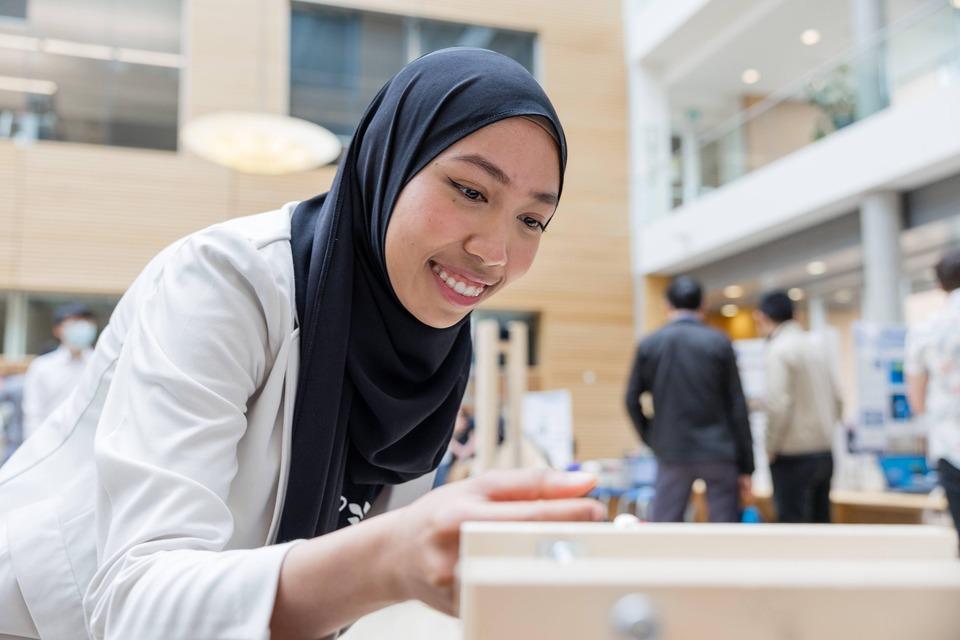
An engineering student at the Design and Innovation day exhibit

A roadmap for future innovators

See how your studies, experiences, and co-op placements connect to help you design your future and make an impact as an engineer.

Roadmap_960*480

UBC is located on the traditional, ancestral and unceded territories of the xʷməθkʷəy̓əm people (Musqueam; which means 'People of the River Grass') and Syilx Okanagan Nation. The land has always been a place of learning for the Musqueam and Syilx peoples, who for millennia have passed on their culture, history and traditions from one generation to the next.

UBC Crest The official logo of the University of British Columbia. Arrow An arrow indicating direction. Arrow in Circle An arrow indicating direction. Caret An arrowhead indicating direction. E-commerce Cart A shopping cart. Time A clock. Chats Two speech clouds. Facebook The logo for the Facebook social media service. Social Media The globe is the default icon for a social media platform. TikTok The logo for the TikTok social media platform. Calendar Location Home A house in silhouette. Information The letter 'i' in a circle. Instagram The logo for the Instagram social media service. Linkedin The logo for the LinkedIn social media service. WhatsApp The logo for the WhatsApp social media service. Location Pin A map location pin. Mail An envelope. Telephone An antique telephone. Play A media play button. Search A magnifying glass. Arrow indicating share action A directional arrow. Speech Bubble A speech bubble. Star An outline of a star. Twitter The logo for the Twitter social media service. Urgent Message An exclamation mark in a speech bubble. User A silhouette of a person. Vimeo The logo for the Vimeo video sharing service. Youtube The logo for the YouTube video sharing service. Future of work A logo for the Future of Work category. Inclusive leadership A logo for the Inclusive leadership category. Planetary health A logo for the Planetary health category. Solutions for people A logo for the Solutions for people category. Thriving cities A logo for the Thriving cities category. University for future A logo for the University for future category.