Applied imagination is the engineer’s super power

why-eng-jan-article39.png

Engineering as applied imagination

Dr. Alon Eisenstein, Associate Professor of Teaching at UBC Okanagan School of Engineering, believes that the secret for great engineering is “applied imagination.” We talked with him about what that means – and how it connects to moon missions, a world of autonomous vehicles and the imaginative legacy of Star Trek. 

prof-alon-headshot.jpg.png

You’ve said that the secret for great engineering is using applied imagination – what do you mean by that?

Engineering is the structured creation of one’s imagination – a purposeful process for turning ideas into reality. 

There is a common way engineering educators think about the difference between scientists and engineers. 

Scientists study the world that is using the scientific method, whereas engineers use scientific knowledge to create a world that is yet to exist.

This bold, purposeful creativity is essential for tackling some of the big issues facing humanity. If we hope to address the climate emergency, for example, we need a profoundly imaginative response that goes far beyond incremental improvements. We’ve faced other existential or seemingly impossible challenges in the past – and our applied imagination has enabled us to achieve things that weren’t thought achievable. 

whyeng-square-set3-logo-small.jpg

What are some past examples of how imagination has driven innovation?

Here’s an example from Canada’s shipbuilding industry. Before World War II, Canada had just over three dozen ocean-going merchant vessels and 13 ships in commission with the Navy. During the war, our shipyards scaled up in just a few years, ultimately producing over 400 merchant ships and 900 naval vessels. Just think about the engineering and manufacturing ingenuity required to achieve this level of production in such a short time.

Or consider the Apollo mission. In 1961, when President Kennedy announced the goal of landing people on the moon before the end of the decade, this target seemed both physically and technologically impossible. 

But that ambitious goal prompted engineers to imagine what astronauts might need to complete their mission – and to then start designing and building those technologies and tools. 

There are lots of everyday technologies that originated from NASA’s activities that supported the Apollo missions. Engineers had to imagine how moon rocks could be collected, which led to the invention of the cordless drill. Nowadays battery-powered devices are everywhere. Astronauts’ visors needed to stay clear during the mission, so anti-fog coating had to be developed. We see the same technology in commonplace products like sports goggles and car mirrors. 

These are just a few examples that show how tackling grand challenges with creativity and applying one’s imagination can lead to innovations that shape our daily lives so many decades after.

whyeng-set20-square-logo-1080x1080.jpg

How do you encourage students to develop this mindset? 

These breakthroughs technologies remind us that when engineers are encouraged to imagine beyond current limitations, the results are transformative to both our present and our future. 

This mindset is just as vital when we ask students to envision solutions for realities that don’t yet exist.

For example, I ask students to imagine a world where all our vehicles are autonomous. What does this mean for urban design and infrastructure in everyday life? What new technologies do we need to ensure seamless communication between vehicles and reduce congestion? What advances in charging infrastructure are required? What about delivery trucks? Who is loading and unloading them? What developments in robotics are required to support a world of fully autonomous vehicles? What uses will we have for the parking spaces we free up?

It brings us back to the Apollo example, which was ridiculously imaginary at the time. Crucially, it was also in the realm of the possible – more Star Trek than Marvel if you ask me.

Tell us more about Marvel versus Star Trek.

There’s lots of cool technology in the Marvel Universe, but it tends to be fantastical and beyond what is possible. I think that a series like Star Trek, on the other hand, provides a great example of operationalizing applied imagination.

Star Trek introduced so many technologies, like the communicators, tricorders, holodecks and replicators, that inspired some of the innovations we can actually see today. 

It’s interesting to me that the show’s creators were known for consulting with scientists and engineers to ask them to imagine a technologically advanced future that was actually feasible. 

They wanted to make sure their ideas were grounded in plausibility – even if it would be decades (in the case of the original Star Trek series) before these technologies became widespread.

How does applied imagination show up in everyday engineering? 

Applied imagination begins with a deep understanding of a problem in all its complexity. There’s a quote that has been attributed to Albert Einstein, although it isn’t likely his, that says, “If I had 60 minutes to solve a major problem, I’d spend 55 minutes thinking about the problem and five minutes thinking about the solution.”

For me, applied imagination means embracing this mindset and recognizing the immense value of problem definition and understanding. 

The first stage of the design cycle – which we teach to students at the beginning of first year and that they will use throughout their careers – is understanding and defining the problem. This is the foundation of applied imagination. 

The first stage of the design cycle

If the current solution is not working well, we need to explore lots of options (divergent thinking) before we choose the best fit for the current context (convergent thinking). That’s creativity in action. 

Is all engineering an act of creativity?

I do believe that engineering is an act of creativity and that engineering design is fundamentally a creative process, even though not all engineering tasks are creative ones. However, when innovation is called for, we need to be able to apply our imaginations in structured ways to help build a future that was previously unimaginable. 
 

Want to know more about UBC Engineering?

Sign up to receive emails from us, and every few weeks we’ll keep you up to date on topics to help you learn more.

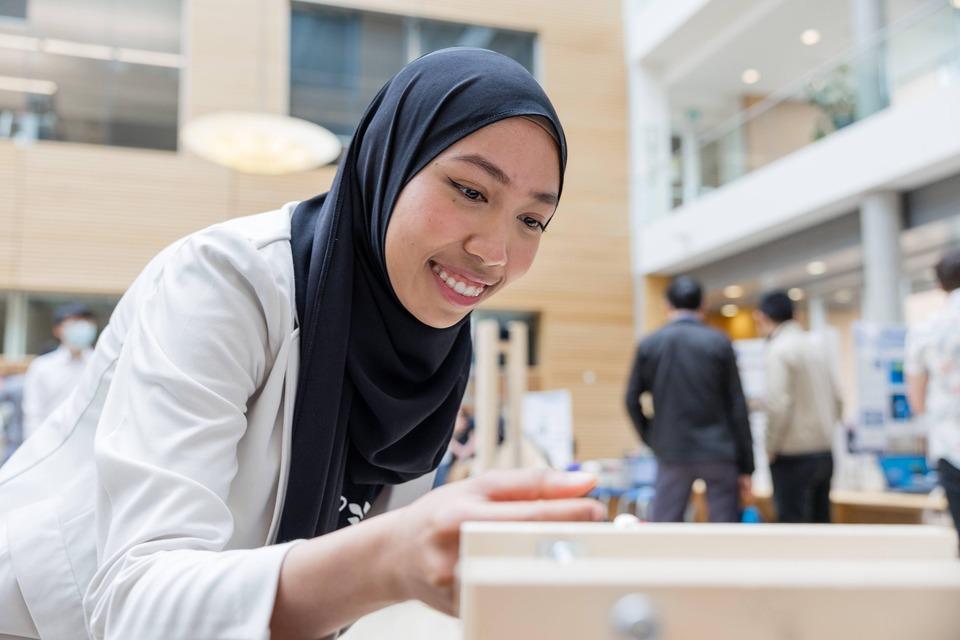
An engineering student at the Design and Innovation day exhibit

A roadmap for future innovators

See how your studies, experiences, and co-op placements connect to help you design your future and make an impact as an engineer.

Roadmap_960*480

Start Your Future at UBC Engineering

You may not know yet if you’re interested in leading an organization. But one thing is certain. Starting your future at UBC Engineering will give you a well-balanced education and sought-after skills – the first step and the foundation for a challenging and rewarding career.

Design & Innovation Day, Kai Jacobson

Latest Research in Action Stories

Learn from professors who are outstanding leaders in their field.

UBC is located on the traditional, ancestral and unceded territories of the xʷməθkʷəy̓əm people (Musqueam; which means 'People of the River Grass') and Syilx Okanagan Nation. The land has always been a place of learning for the Musqueam and Syilx peoples, who for millennia have passed on their culture, history and traditions from one generation to the next.

UBC Crest The official logo of the University of British Columbia. Arrow An arrow indicating direction. Arrow in Circle An arrow indicating direction. Caret An arrowhead indicating direction. E-commerce Cart A shopping cart. Time A clock. Chats Two speech clouds. Facebook The logo for the Facebook social media service. Social Media The globe is the default icon for a social media platform. TikTok The logo for the TikTok social media platform. Calendar Location Home A house in silhouette. Information The letter 'i' in a circle. Instagram The logo for the Instagram social media service. Linkedin The logo for the LinkedIn social media service. WhatsApp The logo for the WhatsApp social media service. Location Pin A map location pin. Mail An envelope. Telephone An antique telephone. Play A media play button. Search A magnifying glass. Arrow indicating share action A directional arrow. Speech Bubble A speech bubble. Star An outline of a star. Twitter The logo for the Twitter social media service. Urgent Message An exclamation mark in a speech bubble. User A silhouette of a person. Vimeo The logo for the Vimeo video sharing service. Youtube The logo for the YouTube video sharing service. Future of work A logo for the Future of Work category. Inclusive leadership A logo for the Inclusive leadership category. Planetary health A logo for the Planetary health category. Solutions for people A logo for the Solutions for people category. Thriving cities A logo for the Thriving cities category. University for future A logo for the University for future category.