Capstone projects are the culmination of your engineering degree. Over two semesters, you’ll have the opportunity to apply everything you’ve learned in your courses to develop a solution to a challenging, open-ended real-world problem, often in collaboration with an industry or community sponsor.
These ambitious, multidisciplinary projects reflect UBC Engineering’s focus on experiential learning, sustainability, innovation and career-ready skill development. For many students, they are one of the most rewarding experiences of their degree.
How capstone works
At the start of your capstone year, you’ll join a team of students in your program to transform an idea into an innovation. UBC has strong connections with local industry leaders, and these companies often sponsor capstone projects so they can benefit from the perspectives and insights of UBC students.
While many capstone projects are sponsored by an industry partner, students can also propose their own capstone projects. In 2026, for example:
- a group of Integrated Engineering students who were backcountry skiers developed an avalanche survival device
- a team of students in Electrical and Computer Engineering developed an AI platform that documents and verifies workflows – and had secured paying customers before the end of the year
- a group of Chemical and Biological Engineering students proposed a novel bioprocess to produce stem-cell-derived CAR-T cells for cancer treatment

Over an eight-month period, students work through the engineering design process to scope out the problem, research and generate potential solutions, test and prototype potential options, and then continue to iterate to come up with the end solution.
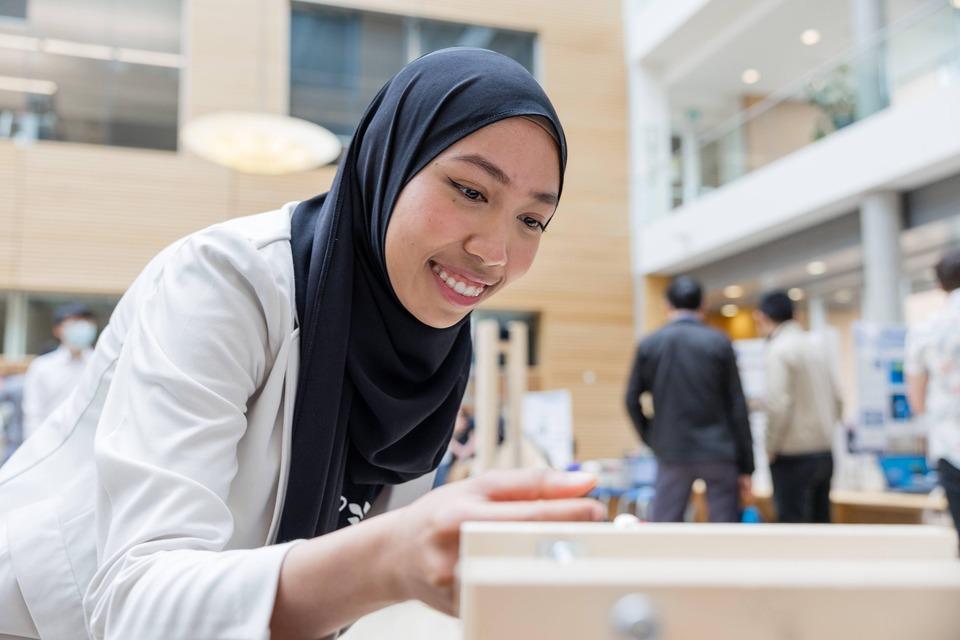
Students are guided by faculty and industry experts, and at the end of the year they present their projects to the university community, industry leaders, friends and family at Design & Innovation Day. It’s an incredible amount of work. And it’s incredibly rewarding.
Learning by doing: From engineering theory to engineering practice
Capstone is a defining feature of UBC’s hands-on curriculum. Throughout your coursework you will have opportunities to apply your learning in practice, generally through labs and projects.
With capstone, you’ll be applying knowledge you’ve acquired over your degree to design, prototype, test and deliver practical and viable solutions.
Theory meets practice in other ways, too. Technical knowledge and skills are not enough to deliver a successful capstone project. Just as important is the need for strong skills in communication, teamwork, conflict resolution, project management, budgeting, timeline management and client liaison.
In essence, the capstone team functions as a mini engineering consulting company, responsible for overseeing and delivering an entire project from start to end.

Other teams worked on projects that advance clean energy and resilient infrastructure, such as:
- Materials Engineering students collaborating with IRDI System to redesign the moisture protection system in hydrogen refuelling nozzles
- Chemical Engineering students working with Solaris to develop a process to produce a sustainable aviation fuel from captured carbon dioxide
- Geological Engineering students working with Klohn Crippen Berger to complete a feasibility-level geotechnical design for a tailings management facility
Many projects enabled students to come up with solutions that address climate resilience and sustainability:
- Civil Engineering students worked with the Danish Hydraulic Institute to propose a redesign of the Stanley Park seawall that will be climate resilient through to 2100, when the sea level is expected to rise by one metre
- Environmental Engineering students proposed ways to mitigate the impact of the urban heat island effect in residential buildings on UBC campus
- Mining Engineering students worked with Skeena Gold and Silver to develop a feasibility study to recover antimony, a critical mineral, within a planned circuit
Building job-ready skills through capstone projects
Employers want to hire people with a blend of technical competence, applied experience and professional skills. Capstone projects are a prime way for you to demonstrate that you can solve hard problems; understand the entire design cycle from problem-scoping to testing and validation; are able to apply a range of tools and methods in your engineering practice; have strong project management and communication skills; and are able to make meaningful contributions to multidisciplinary teams and projects.

Capstone is also a great way to expand your expertise beyond what you’ve learned in your courses or work positions. As the group of mining engineering students said:
“This project allowed us to gain new experience in areas – for example, some of us had more metallurgical experience from co-op positions but were able to gain new skills in economic analysis. We all became more well-rounded over the course of this project.”
Graduate with confidence as you begin your career in engineering
Capstone is a confidence-booster. Students repeatedly state that the one of the major outcomes of their capstone project is the confidence that comes from transforming a project brief into a tangible, innovative solution with real-world impact.
As a group of Chemical and Biological Engineering students stated:
“We took a one-page problem statement and turned it into full process diagrams, a complete economic analysis, a hazard and operability study, a plant layout, and numerous technical presentations and deliverables. It’s been exciting to have so much freedom to make decisions for ourselves – including the freedom to pursue solutions that didn’t work out. We learned a lot about some of these detours and tangents! It’s given us newfound confidence in our skills as we graduate and begin working in the industry.”
Closing the loop: Turning textile waste into feedstock
UBC Engineering students make an impact
UBC is one of the world’s top 50 universities for many reasons – its research power, sustainability leadership, excellence in teaching, and reputation with employers. The university’s embrace of innovation and commitment to shaping a better world is exemplified in the engineering capstone projects and the dedication of UBC Engineering students being a force for positive change.
In 2026, one of the teams of Electrical Engineering students developed a contactless way to monitor vital signs of patients in seclusion rooms. Here’s what they said about their project:
“We came into engineering to find a way to use our skills to make a difference in the world. This project does that by addressing an actual problem in the realm of health care. When we’ve talked with health-care practitioners at various stages of this project they have told us how useful this kind of product could be.

This complex project let us put into practice something we’ve learned since first year: that one of the primary duties of an engineer is to consult with stakeholders and translate their needs into practical, reliable solutions. We were able to integrate seemingly independent sub-system components into a single product that can be deployed in a hospital and change people’s lives – making it easier for health care providers to provide care and for patients to stay safe.
Finally, a key aspect of engineering is teamwork. Throughout this project, we functioned extremely well as a collaborative and respectful team. We each applied our own expertise and helped each other out in areas where we were not as strong so that we could all develop new skills, learn from each other and deliver something meaningful together.”